Motivation
Image Credit: NASA
New Vision into the Early Universe
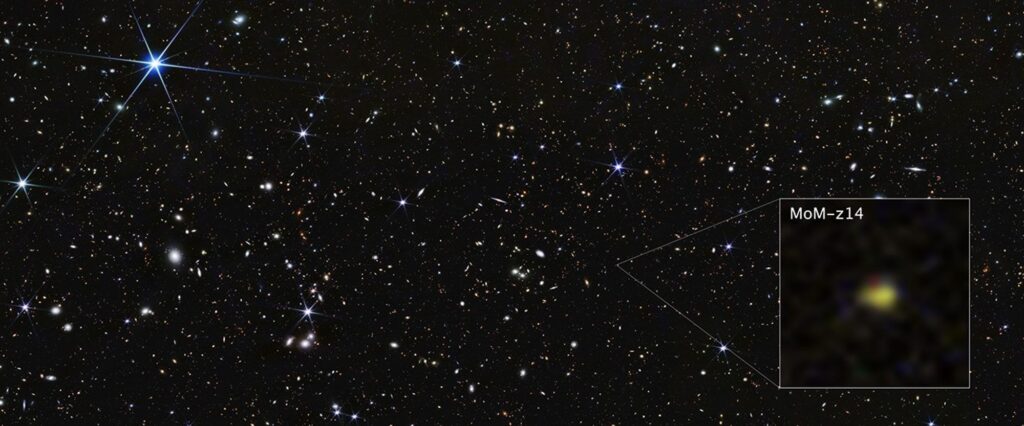
The James Webb Space Telescope (JWST) has allowed scientists to study the early universe in greater detail than ever before. JWST has observed hundreds of galaxies at redshifts z > 8 and approximately 20 galaxies at z > 10, 14 of which have been spectroscopically confirmed. The highest-redshift spectroscopically confirmed galaxy is MoM-z14, at z = 14.44+0.02−0.02 . It was discovered through the “Mirage or Miracle” (MoM) survey using JWST’s Near-Infrared Camera (NIRCam) and confirmed using its Near-Infrared Spectrograph (NIRSpec). Before JWST, the highest-redshift galaxy known was GN-z11, discovered with the Hubble Space Telescope in 2016 with an estimated redshift of z = 11.09+0.08−0.12 . JWST has since observed GN-z11 and refined its spectroscopic redshift to z = 10.60.
JWST Surveys and Findings
Several JWST observing programs have identified the 14 spectroscopically confirmed galaxies with z > 10 included in our comparison sample.
Spectroscopically Confirmed Galaxies with z > 10
- GS-z10-0 — z = 10.38 (JADES)
- GN-z11 — z = 10.60 (JADES)
- CEERS2-588 — z = 11.04 (CEERS)
- Maisie’s Galaxy — z = 11.42 (CEERS)
- GS-z11-0 — z = 11.58 (JADES)
- GLASS-z12 / GHZ2 — z = 12.117 (GLASS)
- UNCOVER-z12 — z = 12.39 (UNCOVER)
- GS-z12-0 — z = 12.63 (JADES)
- UNCOVER-z13 — z = 13.08 (UNCOVER)
- GS-z13-0 — z = 13.20 (JADES)
- PAN-z14-1 — z = 13.53 (PANORAMIC)
- GS-z14-1 — z = 13.90 (JADES)
- GS-z14-0 — z = 14.32 (JADES)
- MoM-z14 — z = 14.44 (Mirage or Miracle)
Insights into Early Star Formation
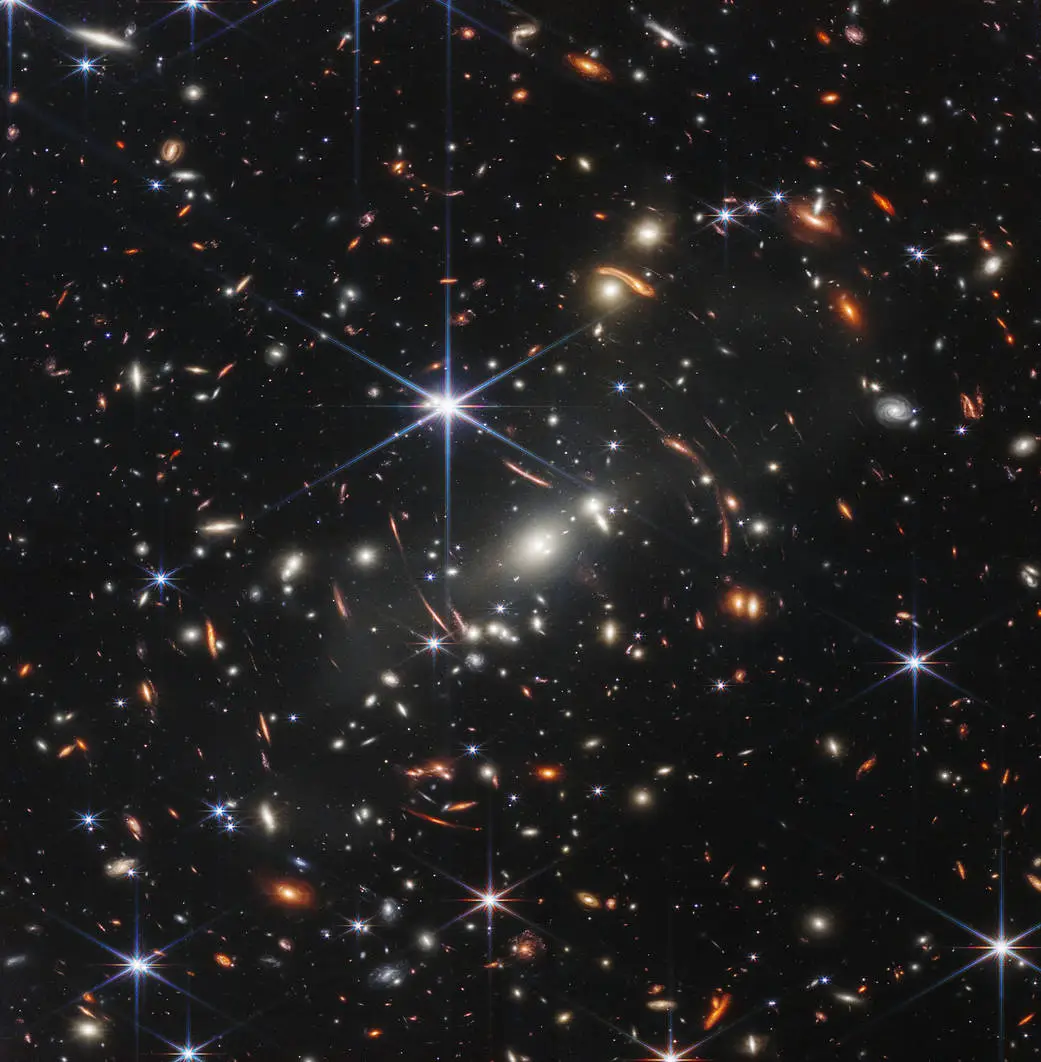
JWST has observed prolonged production of ultraviolet (UV) photons in high-redshift galaxies, indicating that these early galaxies may have been major contributors to the reionization of the young universe. Star clusters within galaxies at z > 6 are thought to contribute significantly to the ionizing-photon budget responsible for cosmic reionization.
The Renaissance Simulations provide the first publicly available database of synthetic observations of high redshift galaxies at created from high-resolution zoom-in simulations. The simulations model the formation of the first stars and galaxies by using its resolution of the early universe inaccessible to larger-volume, lower-resolution simulations.
This website serves as a catalogue of mock JWST observations of high-redshift galaxies created from the Renaissance Simulations. These observations and their corresponding physical properties enable direct comparisons between theory and observation. The database allows researchers to test models of early star formation and predict what JWST may observe in the earliest galaxies.