Understanding the First Galaxies: From the Early Universe to JWST
The James Webb Space Telescope (JWST) is now observing galaxies at redshifts z > 10, meaning we are seeing the Universe less than 500 million years after the Big Bang. This unprecedented access to the early Universe provides a new opportunity to understand how the first stars and galaxies formed and how their radiation began to shape the surrounding intergalactic medium.
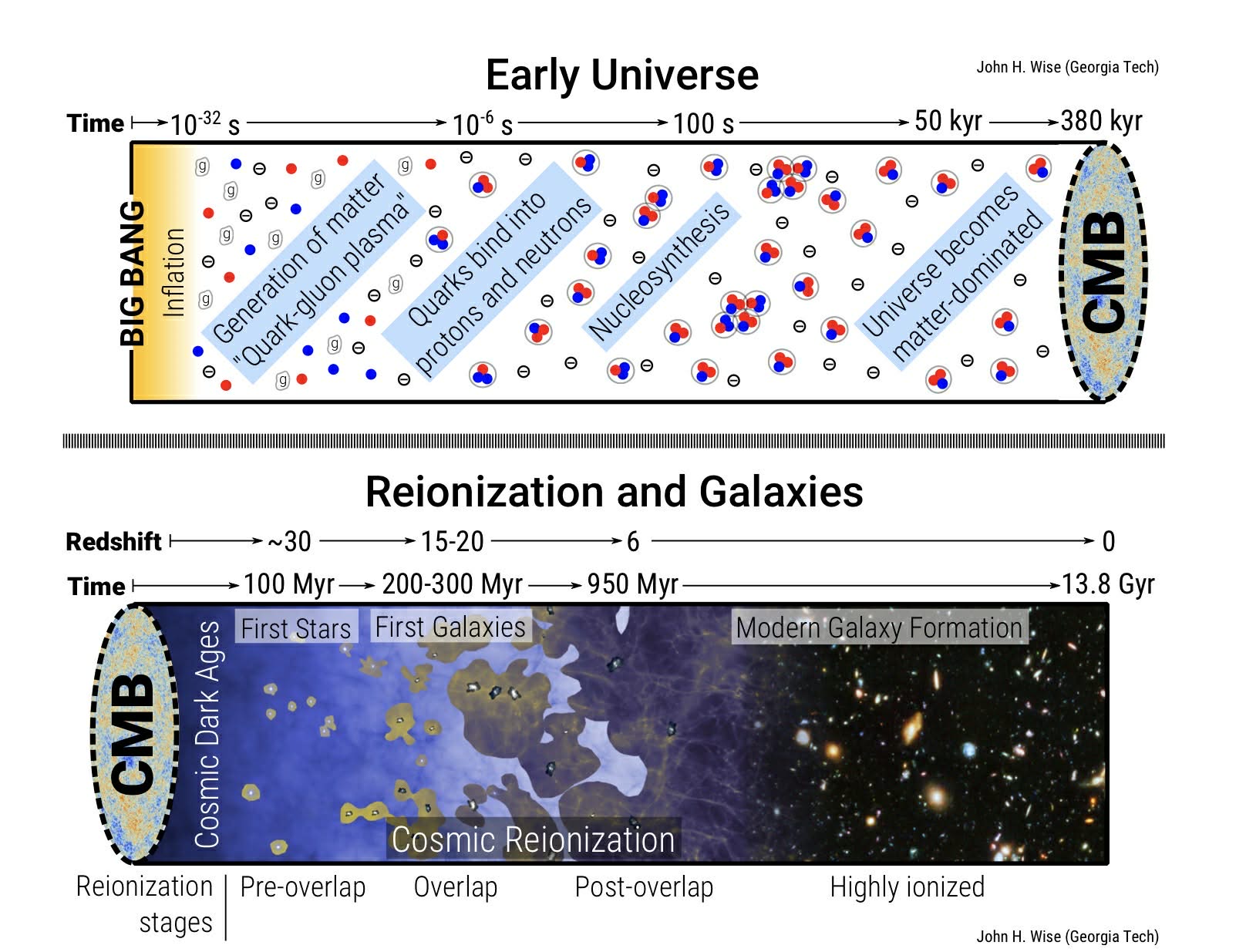
About 13.8 billion years ago, the Universe began with the Big Bang. Spacetime was initially extremely hot and dense, with the four fundamental forces unified.
- ~10-35 seconds (Inflation): The Universe underwent rapid exponential expansion, smoothing out initial conditions.
- First fractions of a second: As the Universe cooled, fundamental particles such as quarks and gluons formed, later combining into protons and neutrons.
- ~1 second: Matter came to dominate over antimatter.
- ~3 minutes (Nucleosynthesis): Fusion produced the first atomic nuclei, primarily hydrogen and helium.
- Up to ~380,000 years: The Universe remained a hot, ionized plasma.
- ~380,000 years (Recombination): The Universe cooled enough for neutral atoms to form, allowing light to travel freely and producing the Cosmic Microwave Background (CMB).
After recombination, the Universe entered the Cosmic Dark Ages, a period when neutral hydrogen filled space and no luminous sources had yet formed. Because electrons were now bound into atoms, photons could travel freely, but there were no stars or galaxies to generate new light. This is because matter had not yet collapsed under gravity into dense enough regions to ignite nuclear fusion. Instead, the Universe was filled with diffuse, cooling gas that emitted very little radiation, making it effectively dark at visible wavelengths. Over time, small density fluctuations grew under gravity, pulling gas into increasingly dense clumps. Once these regions became hot and dense enough, the first stars ignited, producing intense ultraviolet radiation. This newly generated light began to ionize the surrounding hydrogen gas, marking the end of the Dark Ages and the beginning of Cosmic Reionization.
Cosmic Reionization: The First Light of the Universe
After recombination, the Universe entered the Cosmic Dark Ages, a period with no stars and no visible light. As the first stars formed, they emitted high-energy radiation capable of ionizing hydrogen atoms in the surrounding gas.
Ionization occurs when photons with energies above 13.6 eV remove electrons from hydrogen atoms, while recombination occurs when electrons and protons recombine to form neutral hydrogen again. The balance between these processes determines the ionization state of the Universe.
As more galaxies form, their radiation creates expanding H II regions that eventually overlap, leading to a fully ionized intergalactic medium. This marks the end of reionization roughly 1 billion years after the Big Bang.
Dark Matter Halos and Galaxy Formation
Galaxies form inside dark matter halos, which collapse under gravity and provide the potential wells necessary for gas to cool and form stars. These halos grow hierarchically through mergers and accretion, building up the large-scale structure known as the cosmic web.

In order for stars to form, gas must cool efficiently. The first stars — known as Population III stars — form in pristine, metal-free environments and play a critical role in early galaxy evolution by:
- Producing intense ultraviolet radiation
- Driving supernova feedback
- Enriching the Universe with the first metals
The Renaissance Simulations
The Renaissance Simulations are high-resolution cosmological zoom-in simulations designed to model this early epoch of galaxy formation. They follow the formation of nearly 2000 galaxies and ~10,000 Population III stars using the adaptive mesh refinement code Enzo.
These simulations are unique because they resolve:
- Pop III star formation and feedback
- Radiative transfer of ionizing photons
- Gas cooling and metal enrichment
They model three distinct regions of the Universe: Rarepeak, Normal, and Void, each capturing different mass densities and, thus, different environments of early structure formation.
From Simulations to Observations
To compare simulations with JWST observations, we use the dust radiative transfer package, Powderday. Pipeline from simulation data to synthetic JWST observations using Powderday.
The Powderday pipeline combines:
- FSPS (stellar population synthesis)
- Hyperion (dust radiative transfer)
- Cloudy (nebular emission)
To produces realistic predictions for: spectral energy distributions (SEDs) and images . From these SEDs and images, we are able to calculate information on our simulation galaxies' photomery and sizes.
Creating Potential JWST Discoveries
Our work shows that:
- Renaissance galaxies follow the observed trends and formation histories of z > 10 JWST galaxies, extending these trends to lower masses.
- Renaissance galaxy stellar masses range from approximately 103 to 108 M⊙, overlapping with JWST-observed galaxies between approximately 107 and 109 M⊙.
- Simulated star formation rates span approximately 10−4 to 101 M⊙ yr−1, overlapping with the lower end of the 1–20 M⊙ yr−1 range observed by JWST.
- Most simulated galaxies have compact half-light radii between approximately 1 and 10 pc and half-stellar-mass radii around 0.1 kpc.
- Their Sérsic indices range from approximately 0 to 4, with little change in morphology as stellar mass increases.
- Renaissance galaxies are generally bluer than current JWST detections, but their absolute UV magnitudes transition smoothly into those of observed main-sequence galaxies.

Why This Work Matters
This project creates a bridge between theory and observation by providing a public catalog of synthetic JWST observations for early galaxies.
These predictions allow astronomers to:
- Interpret JWST data more accurately
- Understand the formation history of early galaxies
- Test cosmological models in the high-redshift Universe